
Major infrastructure projects demand more than materials. They require precision, coordination, and the ability to execute at an extraordinary scale. The new terminal at Pittsburgh International Airport stands as a clear example of what modern steel fabrication can achieve when design ambition meets technical expertise.
Spanning more than 800,000 feet, the new terrain is not only a transformation of passenger experience but also a structural achievement defined by complexity, volume and craftsmanship. At the heart of the project is an extensive steel system that quite literally shapes the identity of the building. Steel that was fabricated in Niagara Falls, ON by Hodgson Custom Rolling Inc.
Delivering a project of this magnitude required the fabrication and coordination of approximately 16,000 tons of structural steel. That volume alone places the terminal among the most demanding large-scale builds in North America.
This is not simply steel supply. This is full-scale execution.
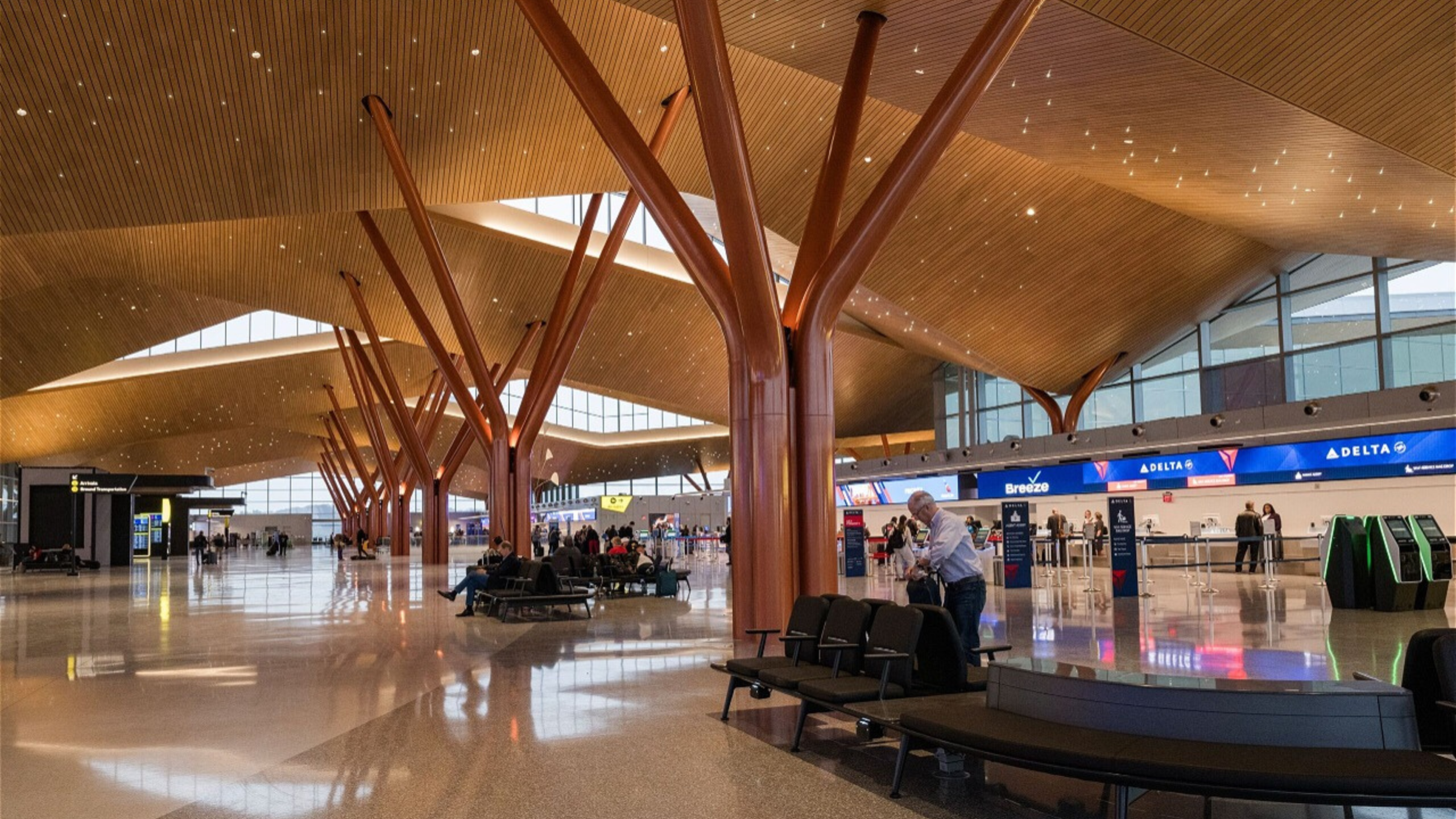
What sets this project apart is how the steel is used. Rather than being hidden behind finishes, the structure is the architecture. The terminal features 38 architecturally exposed structural steel columns, each designed to resemble a tree. These columns are not decorative. They serve as a primary load-bearing elements, using American 1.5’ thick A572 Grade 60 Material to support long-span roof structures reaching up to 120 feet.
Each column branches outward at the top, forming a canopy that distributes structural loads while creating an open, unobstructed interior space. The result is both visually striking and highly efficient, reducing the need for dense column grids while maintaining structural integrity. The 40-foot conical columns creating the tree branches required a level of quality that only a select few organizations can deliver. And that’s where Hodgson Custom Rolling Inc, comes into the equation.
From a fabrication standpoint, this introduces a new level of complexity:
This is where fabrication moves beyond production and becomes craftsmanship.
Executing a project like this requires more than capacity. It requires integration. From early-stage modelling to final installation, every element must align across design, fabrication, and erection. Advanced 3D modelling and coordination ensure that each component fits within a larger system where tolerances are measured in millimetres not inches.
Large structural elements are often fabricated in sections and transported under logistical constraints, and assembled on site in carefully sequenced operations. Each step must account for structural loads, site conditions and installation timelines.
There isn room for rework at this scale.
The Value of Experience at Scale
The new Pittsburgh International Airport terminal is designed to reflect the region itself. Its sweeping rooflines echo the surrounding landscape, while the tree-like columns create a sense of openness and connection to nature.
But behind that experience is an immense structural effort. Every beam, column, and connect contributes to a system that must perform flawlessly for decades.
This is the unseen story of steel fabrication at scale.
As infrastructure projects continue to evolve, so too do expectations. Architects are pushing boundaries. Owners are demanding efficiency and durability. And Structure are increasing required to do more than function, they must inspire.
Meeting those demands requires partners who can operate at scale without compromising precision.
Projects like the Pittsburgh International Airport demonstrate what is possible when that capability exists.
For fabricators equipped to handle it, this is not just a challenge. It is an opportunity to define the next generation of landmark construction.
Image credit –https://www.pittransformed.com/